TL;DR: The Agent Stack
- ?? Lovable: The UI & Orchestration Layer
- ?? Hermes: The Learning & Skill-Building Engine
- ?? OpenClaw: The Multi-Channel Distribution Gateway
- ??? ElevenLabs: Native Voice & Conversational AI
The "Chatbot" era is over. In 2026, founders aren't building interfaces; they are building economies of agents. The challenge has shifted from "How do I prompt?" to "How do I integrate?". While Lovable has simplified the frontend, the real power lies in connecting it to specialized agentic frameworks like **Hermes** and **OpenClaw**. According to industry data, agentic workflows increase MVP development efficiency by over 300% compared to traditional LLM wrappers.
Why Connect External Agents to Lovable?
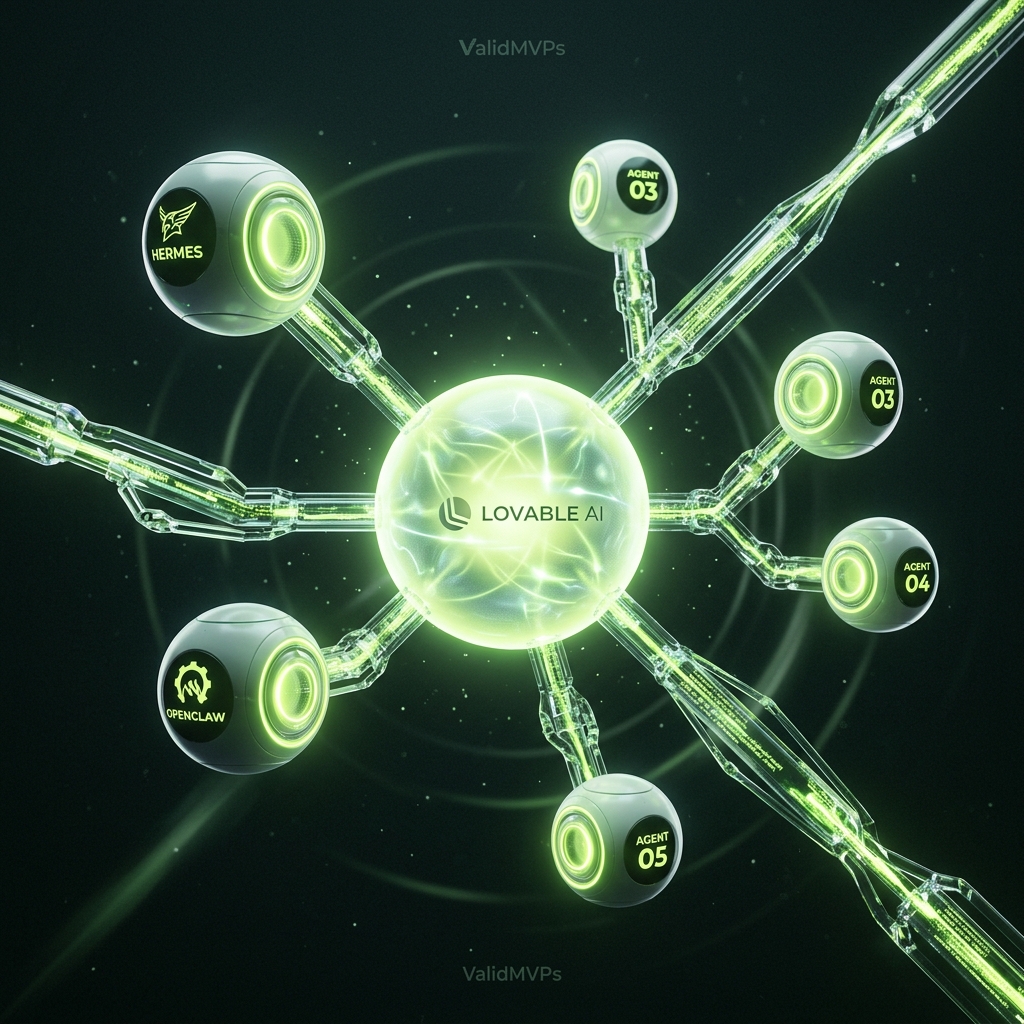
Lovable is exceptional at "vibe coding" your UI, but complex logic often requires specialized agents. **Hermes** provides a self-improving learning loop where the agent creates reusable "skills" over time. **OpenClaw**, on the other hand, acts as a gateway, allowing your Lovable app to control agents across Discord, Slack, and Telegram simultaneously. By bridging these systems, you transform a simple web app into a centralized agentic control plane.
Step 1: The Native ElevenLabs Fast-Track
If your agent needs a voice, start with the **ElevenLabs Connector**. Lovable has built-in support for ElevenLabs' conversational AI agents. Simply navigate to Connectors ? App connectors ? ElevenLabs, drop in your API key, and you can "vibe" a voice assistant into existence. This is the fastest way to add high-fidelity audio interaction to your MVP without managing complex socket connections.
Step 2: Connecting Hermes via Custom API
For specialized tasks, Hermes is your "Chief Learning Officer." To integrate Hermes, you'll use Lovable's Custom API Connector. Hermes exposes an endpoint that accepts task descriptions and returns execution paths. In Lovable, you create a prompt that triggers this API call whenever a user requires a "learned skill" (like complex data analysis or automated research). The agent performs the task, updates its skill-base, and returns the result to your UI.
Step 3: Orchestrating with OpenClaw
If your MVP needs to "take actions" across different platforms, OpenClaw is the answer. It provides a centralized control plane for multi-agent workflows. You can use OpenClaw to:
- Multi-Channel Reach: Control bots on Discord, Slack, and Telegram from your Lovable dashboard.
- Skill Registry: Access pre-built "Claws" for web searching, document processing, and image generation.
- Actionable Agents: Allow agents to execute code or interact with third-party SaaS APIs on behalf of the user.
Conclusion: The Agentic Future of MVPs
The integration of agents like Hermes and OpenClaw into Lovable marks a shift toward **AI-Native Software**. Your application is no longer a tool for the user to work with; it's a teammate that works for the user. As we move further into 2026, the winners will be those who master these agentic orchestration patterns. If you're looking to build an agentic MVP that scales, book a technical strategy session with ValidMVPs.